
The IONA® Nx NIPT Workflow is a CE marked in vitro diagnostic (IVD) device for prenatal screening which enables clinical laboratories around the world to establish their own quality assured non-invasive prenatal screening service.
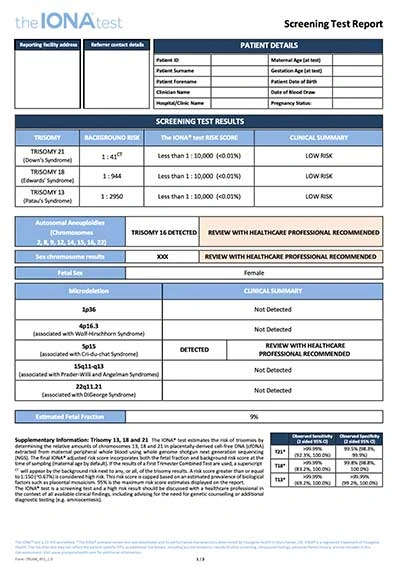
The IONA® Nx NIPT Workflow is a fully validated workflow which utilises Next Generation Sequencing technology, to estimate the risk of a fetus having Trisomy 21, Trisomy 18, Trisomy 13, Autosomal Aneuploidies (AA), Sex Chromosome Aneuploidies (SCA) and the most clinically relevant microdeletions.
The IONA® Nx NIPT Workflow is suitable for use from 10 gestational weeks for singleton or twin pregnancies. The workflow can deliver results from 2 to 3 days.

Sex Chromosome Aneuploidies
The IONA® Nx NIPT Workflow screens for the following sex chromosome aneuploidies:
Rare Autosomal Aneuploidies
The IONA® Nx NIPT Workflow estimates the risk of a fetus having Down’s syndrome (Trisomy 21), Edwards’ syndrome (Trisomy 18) and Patau’s syndrome (Trisomy 13). In addition, a genome-wide aneuploidy detection analysis on the remaining chromosomes can be carried out and reported.
Microdeletions
Microdeletion syndromes are caused by chromosomal deletions that include several genes, but that are too small to be detected by conventional methods such as karyotyping. A microdeletion is identified by genomic position and by size, and many result in a clinically benign phenotype, however some are characterised by a complex disorder. Syndromes associated with microdeletions can present with a range of clinical features, including: intellectual disabilities, developmental delay, heart defects and failure to thrive.
The vast majority of microdeletions occur de novo i.e. they are not inherited from the parents. In some cases, however, they can be inherited from an apparently unaffected parent. Unlike common trisomies, microdeletions are not thought to be associated with advanced maternal age. Younger pregnant women statistically have a higher risk of a sub-microscopic aberration than for Trisomy 21. This also must be considered in pregnancies resulting from egg donation.
We are able to screen for 5 clinically significant microdeletions ( ≥3 Mb) associated with the following conditions:
- DiGeorge/Velocardiofacial syndrome (22q11.2 deletion)
- 1p36 deletion syndrome
- Prader-Willi syndrome (15q11.2-q13 paternal deletion)
- Angelman syndrome (15q11.2-q13 maternal deletion)
- Cri-du-Chat syndrome (5p15 deletion)
- Wolf-Hirschhorn syndrome (4p16 deletion)
Fetal Sex Determination
Upon request, the fetal sex can be determined with 99.5% accuracy.

Fetal Fraction
In order to minimise the risk of a false negative test result, the IONA® Nx NIPT Workflow estimates the fraction of circulating cell-free DNA which comes from the fetus (fetal fraction), relative to the cell-free DNA from the mother. The IONA® Nx NIPT Workflow incorporates clever bioinformatics software that is able to produce valid and accurate results in samples that have as little as 2.0% fetal fraction.

This test is registered as a regulated IVD in many different regions. Yourgene Genomic Services use the IONA® Nx NIPT Workflow in our Manchester laboratory (UK) to offer a quality NIPT testing service.
The IONA® Nx NIPT Workflow is a highly flexible NIPT solution which can be easily scaled to meet the testing demands of your clinical laboratory. It is available as both an automated and manual workflow offering between 12 and 96 patient samples per sequencing run on the Illumina NGS platform.
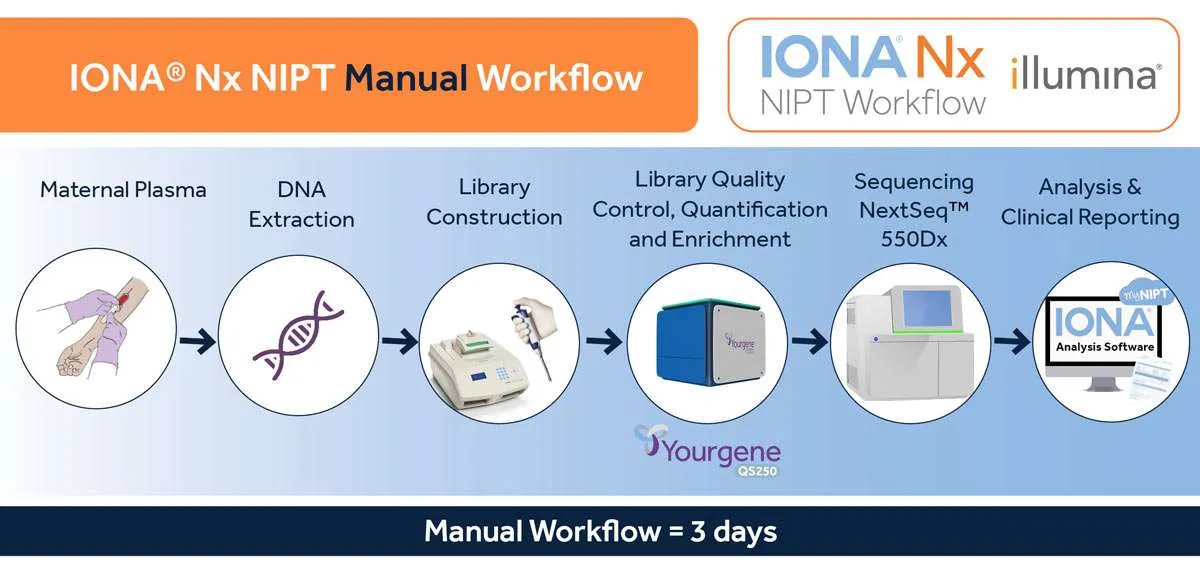
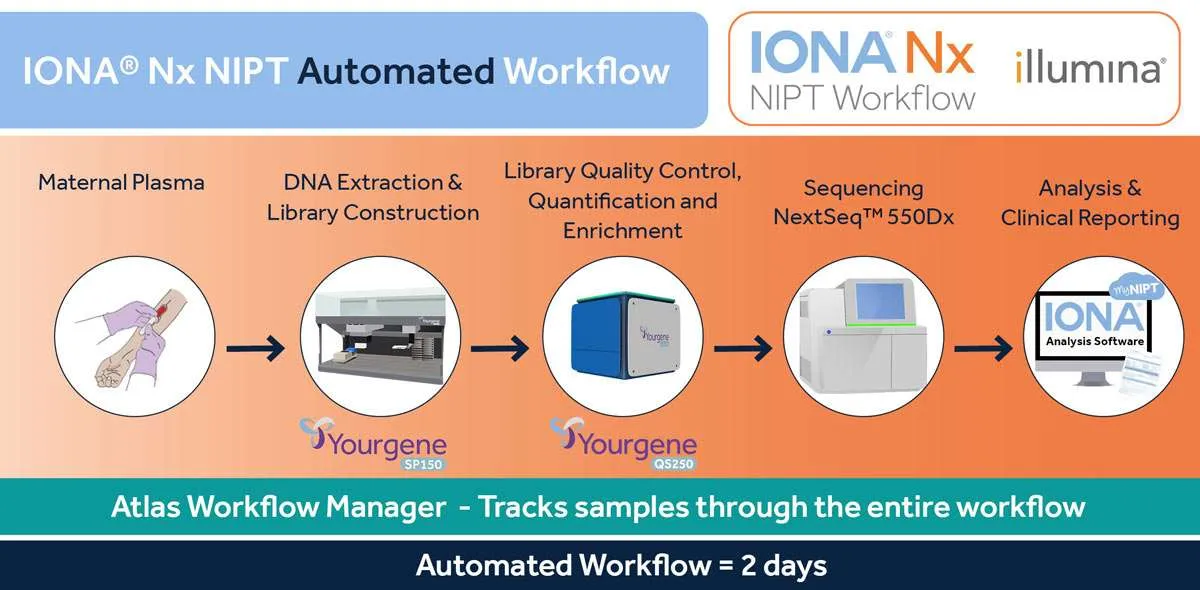
IONA® Nx NIPT Workflow
The automated workflow utilises the Yourgene® SP150 liquid handling robot for automated DNA extraction and library construction to reduce hands on time and provide a more streamlined workflow.
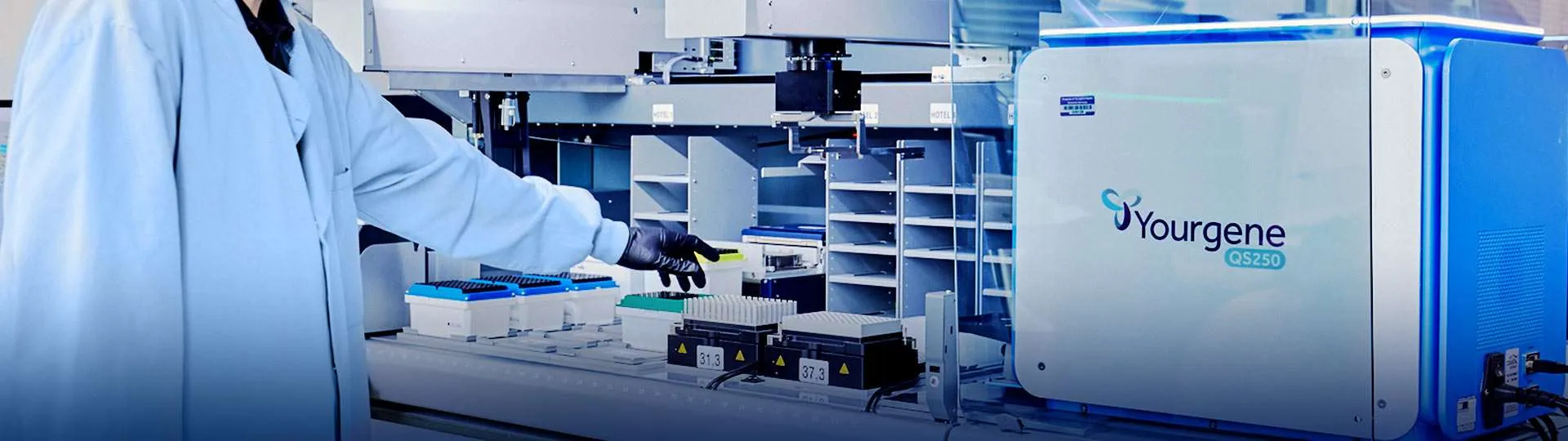
The IONA® Nx NIPT workflows utilise the Yourgene® QS250, powered by Ranger® Technology. Ranger® Technology allows automated high-throughput target enrichment of cell-free DNA (cfDNA) NGS library constructs prior to sequencing, enabling great improvements in fetal fraction enrichment.
In NIPT, Ranger® Technology next generation size selection and enrichment enables labs to get the results they are looking for first time, reducing failure rates and improving precision, enabling more pregnant mothers to receive a safe, fast and accurate screening result.
NIPT Analysis
Yourgene has developed its own automated, custom, dedicated bioinformatics analysis software as part of the IONA® Nx NIPT clinical workflow. The IONA® Software employs highly efficient, multi-core analysis algorithms. It analyses the relative amount of chromosomes 21, 18 and 13 to calculate a risk score for the presence of a trisomy. This result is then further detailed by automatically combining it with the age-related risk of the mother at the time of sampling to calculate an adjusted probability of the fetus being affected. A results report is generated individually for each patient. The IONA® Software allows secure local data analysis, it is not cloud-based, and no bioinformatics personnel are required.
Screening test results can be sent to clinics using the MyNIPT® portal, our safe and secure data exchange portal.
Easy Sample Management and Tracking
The Atlas Workflow Manager is a custom, comprehensive Data Management System (DMS) which can interface with your LIMS systems to track your clinical samples and reagents from start to reporting.
The clinical performance of the IONA® Nx NIPT Workflow is assessed as part of the development process prior to product launch. Post-launch, as required by the medical device regulation and for our quality system we monitor performance via Post-Market Surveillance (PMS). Post-market surveillance is a set of activities conducted by manufacturers to collect and evaluate experience gained from medical devices that have been placed on the market. It is done with the intention of ensuring we can identify any trends that suggest the need to take any action e.g. withdrawing a faulty batch from the market.
Validation Data:
The data from both the initial validation work and the latest post-market surveillance activities is provided below:
IONA® Nx trisomy validation study A
| Sensitivity | Specificity | |
|---|---|---|
|
Trisomy 21
(Down’s Syndrome) |
>99.99%
(46/46) 95% CI: 92.3 - 100% |
>99.99%
(426/426) 95% CI: 99.1 – 100% |
|
Trisomy 18
(Edwards’ Syndrome) |
>99.99%
(20/20) 95% CI: 83.2 – 100% |
>99.99%
(452/452) 95% CI: 99.2 – 100% |
|
Trisomy 13
(Patau’s Syndrome) |
>99.99%
(10/10) 95% CI: 69.2 – 100% |
>99.99%
(462/462) 95% CI: 99.2 – 100% |
A Validation performance has been demonstrated by evaluating 472 clinical samples from singleton and monochorionic/dichorionic twin pregnancies and comparing them to a reference result. Reference results include an amniocentesis or chorionic villus sample (CVS) sample or a birth outcome.
IONA® Nx additional validation study B
| Sensitivity | Specificity | |
|---|---|---|
|
XO
(Turner Syndrome) |
>99.99%
(15/15) 95% CI: 78.2 – 100% |
>99.99%
(428/428) 95% CI: 99.1 – 100% |
|
XXY
(Klinefelter syndrome) |
>99.99%
(4/4) 95% CI: 39.8 – 100% |
99.5%
(437/439) 95% CI: 98.4 – 99.9% |
|
XYY
(XYY Syndrome) |
N/A
|
>99.99%
(443/443) 95% CI: 99.2 – 100% |
|
XXX
(Trisomy X) |
>99.99%
(1/1) 95% CI: 2.5 – 100% |
>99.99%
(442/442) 95% CI: 99.2 – 100% |
|
Autosomal Aneuploidy
|
>99.9%
(3/3) 95% CI: 29.2 – 100% |
99.3%
(439/442) 95% CI: 98.0 – 99.9% |
|
Monosomy
|
N/A
|
>99.9%
(442/442) 95% CI: 99.2 – 100% |
B Validation performance has been demonstrated by evaluating 443 clinical samples from and comparing them to a reference result. Reference results include an amniocentesis or chorionic villus sample (CVS),or a birth outcome.
This has been demonstrated using the IONA® Nx cfDNA Library Preparation DX kit and the IONA® analysis software version 2.0.2. Data held on file by Yourgene Health Plc.
Dichorionic Twins
The above data for IONA® Nx trisomy validationA is from a sample set that includes singleton, monochorionic and dichorionic twin pregnancies. Please note that in dichorionic twins, the test sensitivity for Trisomy 21 has been observed in our Genomic Services laboratory to be reduced from >99% to about 95%. The IONA® Analysis Software uses a specific proprietary algorithm iteration for dichorionic twins, but it will not distinguish which twin is high risk. Please note that the additional validation studyB results do not include data from dichorionic pregnancies. Therefore, sex chromosomal aneuploidy and autosomal aneuploidy analysis have not been validated for application in dichorionic twins at this time. Fetal sex determination is not available for twins.
Post-Market Surveillance
IONA® Nx NIPT Workflow performance following post-market surveillance of pregnancies. Please note data is not available at this time for additional conditions detectable by the test other than the trisomies listed below. Data is also not yet available as a breakdown of single, monochorionic and dichorionic pregnancies. Please note that in dichorionic twins, post market surveillance data specifically from our Genomic Services laboratory has shown sensitivity for Trisomy 21 to be reduced from >99% to about 95%.
Global IONA® Test performance observed following Post-Market Surveillance on 76,989 singleton, mono & dichorionic twin pregnancies:
| Condition | Observed Sensitivity | Observed Specificity | Observed Positive Predictive Value (PPV)b | Observed Negative Predictive Value (NPV)b | Observed False Positive Rate | Observed False Negative Rate | Prevalence for the population tested |
|---|---|---|---|---|---|---|---|
|
Trisomy 21
Down’s Syndrome (1,362 / 76,989) |
99.49%
(1,355 / 1,362) 95% CI: 98.95-99.79% |
99.99%
(75,621 / 75,627) 95% CI: 99.98-100% |
99.56%
|
99.99%
|
0.0079%
|
0.0093%
|
1.77%
|
|
Trisomy 18
Edwards’ Syndrome (430 / 76.989) |
97.91%
(421 / 430) 95% CI: 96.73-99.35% |
99.99%
(76,548 / 76,559) 95% CI: 99.97-99.99% |
97.45%
|
99.99%
|
0.0144%
|
0.0118%
|
0.56%
|
|
Trisomy 13
Patau’s Syndrome (203 / 76,989) |
99.51%
(202 / 203) 95% CI: 97.30-99.99% |
<99.99%
(76,781 /76,786) 95% CI: 99.98-100% |
97.58%
|
>99.99%
|
0.0065%
|
0.0013%
|
0.26%
|
a Observed performances are based on Post-Market Surveillance of the IONA® Nx workflow in singleton and monochorionic twin pregnancies, from a population of women who are predominantly at a higher risk of having a fetus with Down’s syndrome (see prevalence for the population tested). Performances are dependant of laboratories fully reporting discordant results to Yourgene Health as they occur. From data held on file by Yourgene Health. Correct as of 31st Oct 2023.
Global IONA® Test performance observed following Post-Market Surveillance of singleton & monochorionic twin pregnancies for SCAs, AAs and microdeletions Screening:
| Condition | Observed Sensitivity | Observed Specificity | Observed Positive Predictive Value (PPV) | Observed Negative Predictive Value (NPV) | Observed False Positive Rate | Observed False Negative Rate | Prevalence for the population tested |
|---|---|---|---|---|---|---|---|
|
SCA
Sex Chromosome Aneuploidy (157 / 13,924) |
98.73%
(155 / 157) 95% CI: 95.53-99.85% |
99.96%
(13,762 / 13,767) 95% CI: 99.92-99.99% |
96.88%
|
99.99%
|
0.0363%
|
0.0145%
|
1.13%
|
|
AA
Autosomal Aneuploidy (75 / 12,006) |
>99.99%
(75 / 75) 95% CI: 95.20-100% |
99.96%
(11,926, / 11,931) 95% CI: 99.90-99.99% |
93.75%
|
>99.99%
|
0.0419%
|
<0.0000%
|
0.62%
|
|
Microdeletions
(10 / 747) |
>99.99%
(10 / 10) 95% CI: 69.15-100% |
>99.99%
(737 / 737) 95% CI: 99.50-100% |
>99.99%
|
>99.99%
|
<0.0000%
|
<0.0000%
|
<1.34%
|
a Observed performances are based on Post-Market Surveillance of the IONA® Nx workflow in singleton and monochorionic twin pregnancies, from a population of women who are predominantly at a higher risk of having a fetus with Down’s syndrome (see prevalence for the population tested). Performances are dependant of laboratories fully reporting discordant results to Yourgene Health as they occur. From data held on file by Yourgene Health. Correct as of 31st Oct 2023.
Definitions
- Sensitivity (True Positive Rate): The proportion of truly affected pregnancies that screen positive
- Specificity(True Negative Rate): The proportion of truly unaffected pregnancies that screen negative
- False Negative Rate(FNR): The proportion of pregnancies that have the syndrome but have screened negative
- False Positive Rate(FPR): The proportion of pregnancies that do not have the syndrome but have screened positive.
- Positive Predictive Value (PPV) (Diagnostic Precision)*: The likelihood that a screened positive pregnancy, is truly affected with a trisomy.
- Negative Predictive Value (NPV)* The likelihood that a screened negative pregnancy, really doesn’t have a trisomy.
* Predictive values are more relevant than sensitivity and specificity for clinical decision and counselling of patients as they represent the actual performance in the test population.